
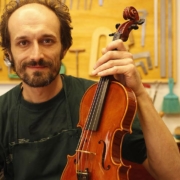
BLUE DANUBE VIOLINS: Dear Federico, we have sold some of your beautiful violins in our shop in Vienna, Austria to customers from countries like Australia, Japan, China, among others. How do you feel about your violins being sold all over the world and becoming an important part of these people’s lives, bringing them lots of joy?
FEDERICO FALASCHI: It is such a great pleasure for me to hear that musicians choose my violins to express themselves through music. They are being played all over the world and that brings me great satisfaction. At the same time, it challenges me to make higher quality instruments, that will give beautiful experiences to people living so far away from me. Violin making is not a job, it is rather a never-ending process of researching the wood, the sound, the varnish, the thicknesses, the style and so on. Sometime I ask myself if it is possible for the musicians playing my instruments to understand what my intentions and feelings during the process of building it were. Because every violin is absolutely unique, there is not one similar to the other.
BLUE DANUBE VIOLINS: Can you please tell us a few things about your background and how did you become interested in the world of violin making?
FEDERICO FALASCHI: When I was 20 years old, my guitar accidentally dropped and cracked on one side. I didn’t know what to do and went to the music shop where I bought it. They sent me to a neighboring luthier. It was my first time visiting a violin making workshop, and I was fascinated by the perfume, the sounds and the magic atmosphere surrounding me. I visited this workshop several times, and every time I felt the same magic, it was such a powerful attraction, everything was fascinating and very close to my heart, to my soul, it was what I was really looking for. The following year I enrolled into a violin making school, and that’s how my professional career began.
BLUE DANUBE VIOLINS: In terms of Italian violin making school, do you belong to certain school or do you feel you rather developed your own method?
FEDERICO FALASCHI: One of the most important things for a luthier is to ‘infect’ an instrument with his own style, which is an expression of elegance, precision, estro and substance. I am lucky to be familiar with several Italian violin making schools: the Tuscan, the Cremona and Milano schools. Later on I moved to Emilia-Romagna: Bologna, Ferrara, Modena and Parma have a fascinating violin making history that gave birth to important luthiers from the early 1900s like Fiorini, Soffritti, Pollastri, Candi, the pioneers of the second Golden Age of the Italian Lutherie.
Working for some years in the Frignani Lorenzo’s workshop (President of A.L.I. Italian Professional Violin Maker), I had the opportunity to learn what makes an instrument an excellent one. I have captured the beauty from all experience into a style that expreses my personality.
BLUE DANUBE VIOLINS: Violin making involves a lot of knowledge and skills. Is there something in particular that fascinates you about the process of making a violin?
FEDERICO FALASCHI: There are many things that fascinate me in the process of making a violin. The choice of wood before starting is one such exciting moment. Imagining the finished violin and its characteristics. Shaping the surface, drawing and cutting the’ff’s. Sculpting the neck. Varnishing. All things that identify a violin and that will make the difference.
BLUE DANUBE VIOLINS: How many months does it take you to make a violin?
FEDERICO FALASCHI: It takes about two months to make a violin. There are violin makers which make three or four instruments at the same time in order to reduce the working time. I personally prefer to make them one by one. Each violin has its own story and it needs my exclusive attention.
BLUE DANUBE VIOLINS: Do you make other instruments than violins? If yes, is it very different than the violin making and how?
FEDERICO FALASCHI: Working for several years with Master Frignani in his workshop in Modena, I had the opportunity to learn the construction method of classical guitars. It is a very different work compared to making string instruments. The strings work in traction and rotation, not in percussion. The surfaces are flat and in no need of carving.
There is a lot of skill involved in the guitar making as well. It needs great workmanship and sensitivity, but in my opinion the result will depend on the initial project. While in the case of making violins, violas and cellos, many decisions are made during the process of working the wood, as a result of feeling the wood.
BLUE DANUBE VIOLINS: If you would have the opportunity to meet a great master/violin maker from the past and ask him a question, whom would you like to meet and what would that question be?
FEDERICO FALASCHI: I would certainly like to meet some Italian masters of the Amati School in the XVII century, when art and craft were one and the same thing, when the math study was mixed with empirical reflections, when the modern violins, as we know them today, were created. More than asking them a question, I’d like to spend time in their workshop and recover the lost knowledge from that time.
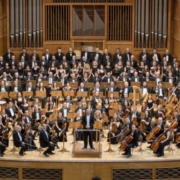
Celebrating its ninetieth year, Bulgaria’s National Orchestra, the Sofia Philharmonic, will perform an orchestral concert in the legendary Goldener Saal of Vienna’s Musikverein on Thursday evening, 5 December 2019, at 19.30.
The program features the Bulgarian Rhapsody ‘Vardar’, op. 16, by Bulgaria’s most important composer, Pancho Vladigerov (1899-1978); Igor Stravinsky’s brilliant, Suite from the Firebird Ballet (1919 version); and the Symphony No. 9 (From the New World) by the famous Czech composer, Antonin Dvorak.
Many of classical music’s best-known composers, soloists and conductors have performed with the Sofia Philharmonic Orchestra through the years, including Dmitri Shostakovich, Igor Oistrakh, Neville Marriner, Kurt Masur, Sviatoslav Richter, Joshua Bell and many more. The concert will be conducted by the orchestra’s music director and chief conductor, Nayden Todorov, who was appointed in early 2017.
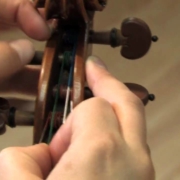
Step-by-step guide to changing a violin string:
Before changing the string, make sure you have ready the new string, a soft pencil and sticky tape (about 4 cm long).
1. Unwind the tuning peg and remove the old/broken string. Be careful not to scratch the varnish.
2. Use the pencil to lubricate the bridge and nut where the string makes contact. The goal is to allow the string to pass easily over the nut and bridge as it is tuned up to pitch. If using an E string with a bridge protector (little piece of plastic that slides up and down the string) then don’t lubricate the bridge under the E string.
3. Run the string between your thumb and index finger, removing any twist in the string, and attach the end of the string to the tailpiece or fine-tuner.
4. Hold the string firmly at the end of the fingerboard and fix it temporarily with the sticky tape.
5. Place the string carefully in the appropriate peg hole. Check to see that the string is running directly from the peg to the nut to the bridge to the tailpiece, not twisted with another string or wrapped around anything it shouldn’t be. Wind the peg to remove the slack, and place a small amount of tension on the string. Thread the end of the string through the peg-hole so that a small amount (approximately 1 mm) sticks out the other side of the peg.
When Buying a Stringed Instrument for a Beginner or in a Lower Price Range
Be Sure the Size is Right —
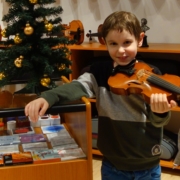
For children it’s especially important the instrument size be proportional. This is best determined by an experienced sales person at a shop that deals with violin-family instruments (violin, viola, cello or double bass) or with the help of a string teacher that works with young people. For adults who play the violin, those with smaller hands might consider a 7/8-size which although sometimes hard to find can be worth the effort. Violas come in a variety of sizes from ca. 38 to 42 cm of body length or more. The average seems to be about 16 inches or 40.5 cm. Cellos and their bows come in fractional sizes (similar to violins) while ¾- double basses are fine for most adult players. Smaller size basses are available too.
Generally, look for European instruments and Bows. Chinese instruments and bows are improving all the time but it’s probably fair to say the least expensive instruments and bows a shop offers will be Chinese. These instruments can sometimes be affected by the extreme difference in weather and humidity conditions between the east coast of China and Europe or North America. Instruments made solely in Europe are difficult to find in fractional sizes (3/4 , ½, ¼, etc.) but are often preferred in full sizes. German, Czech, Romanian, Bulgarian, Polish & Hungarian instruments are especially good in the lower price ranges.
Outfit or Individual Elements? It’s usually less expensive to buy a set or outfit (instrument, bow & case) than the individual elements separately. However, buying a better violin (especially in fractional size) can be easily paired with an inexpensive and basic case and
Match the Level of the Bow and Its Price to the Instrument’s. As a rule of thumb, we advise to spend about 20% of the value of a violin, viola, cello or double bass on its bow. If an instrument is 500 Eur or USD, 100 for a bow will make it much more likely to have a qualitative match.
Average and General Weight of Bows
Violin bows (full size) – from 60 to 62 grams
Viola bows – 68 to 72 grams
Cello bows – 78 to 86 grams
Ask the shop to weigh the bow for you, if possible
Shoulder Rests, Rosin and Cleaning and Maintainence Products should also be considered, buying from a knowledgeable and specialized shop. With shoulder rests it’s a good idea to see what the teacher requires for beginners, some go with sponges or other makeshift solutions before they ask students to buy commercial shoulder rest.
